




Table of Contents
- What Is a Long-Range Electric Bike?
- Why Range Matters More Than Speed
- What Actually Affects Electric Bike Long Range
- How to Compare Long-Range Ebikes: Key Specs Explained
- Long-Range Ebike Categories: Which Type Fits You?
- Side-by-Side Comparison: Top Long-Range Ebike Profiles
- Use Cases: Who Should Buy What
- Buying Guide: 7 Questions to Ask Before You Buy
- FAQ
What Is a Long-Range Electric Bike?
An electric bike long range model is generally defined as one capable of traveling 50+ miles (80+ km) per charge under real-world conditions — not just the manufacturer's best-case lab figure. The term gets thrown around loosely in marketing, so understanding what it actually means in practice is the first step to making a smart purchase.
Most entry-level ebikes ship with 36V/10Ah batteries, delivering roughly 20–35 miles of real range. True long-range models typically run 48V/17.5Ah or higher, with premium off-road builds like the HiKNiGHT H6 Pro and the HiKNiGHT H2 Pro utilizing high-voltage 52V/20Ah (1040Wh) battery systems to exceed standard limits, delivering an official range of up to 65–90 miles per charge. The difference isn't just about battery size — motor efficiency, frame geometry, tire width, and how you ride all play significant roles.

Why Range Matters More Than Speed
Speed is the spec most buyers fixate on. Range is the one that determines whether you actually enjoy the bike.
Here's why: most US states cap ebike-assisted speed at 20 mph (Class 1/2) or 28 mph (Class 3). You can't legally go faster regardless of motor power. But range anxiety — the creeping worry that you'll run out of battery mid-ride — is a real psychological barrier that affects how freely you ride.
Riders who commute 15–20 miles each way, explore trails on weekends, or live in hilly terrain consistently report that range is the #1 thing they wish they'd prioritized when buying their first ebike. A bike with 80 real-world miles of range doesn't just go farther — it changes how you plan your day.
- Commuters: No more calculating whether you can make it home without a charge
- Adventure riders: Explore longer trails without turning back early
- Cargo haulers: Extra load reduces range — a buffer matters
- Rural riders: Charging infrastructure is sparse; range is a safety net
What Actually Affects Electric Bike Long Range
Manufacturers quote range under ideal conditions: flat road, 165 lb rider, low assist, 68°F. Real-world range is almost always lower. Here's what moves the needle most:
1. Battery Capacity (Wh)
Watt-hours (Wh) = Voltage × Amp-hours. For example, the HiKNiGHT H2 Pro and HiKNiGHT H6 Pro feature a 52V × 20Ah setup, yielding 1040Wh of total capacity. This is the single biggest determinant of range. As a rough rule: every 100Wh delivers approximately 10–15 real-world miles depending on conditions.
2. Motor Efficiency
Hub motors (rear or front) are simpler and cheaper. Mid-drive motors are more efficient because they leverage the bike's gearing system, making them better for hilly terrain. However, advanced systems can deploy highly optimized dual-hub designs to deliver impressive low-end torque and high efficiency over rolling hills.
3. Rider Weight + Cargo
Every additional 20 lbs of rider weight or cargo reduces range by roughly 5–10%. A 250 lb rider on a bike rated for 60 miles might realistically see 45–50 miles.
4. Terrain & Elevation
Climbing hills is the fastest way to drain a battery. A route with 1,000 ft of elevation gain can cut range by 20–30% compared to flat ground.
5. Tire Width & Pressure
Fat tires (4"+ width) offer superior traction and comfort but create more rolling resistance. Properly inflated tires at the right PSI for your terrain can recover 5–10% of range.
6. Assist Level
This is the most controllable variable. Riding in Eco or Level 1 assist vs. Turbo/Level 5 can double your range. Most experienced long-distance riders use mid-level assist and pedal actively.
7. Temperature
Lithium batteries lose 15–25% capacity in cold weather (below 40°F). If you ride year-round in a cold climate, factor this into your range expectations.

How to Compare Long-Range Ebikes: Key Specs Explained
When you're evaluating specs on a product page, here's what each number actually means for your riding experience:
| Spec | What It Means | Long-Range Benchmark |
|---|---|---|
| Battery (Wh) | Total energy storage | 1000Wh+ for 60+ mi range |
| Motor (W) | Peak power output | 1500W–3000W peak output |
| Motor Type | Hub, dual-hub, vs. mid-drive efficiency | Dual-hub preferred for steep climbs & off-road |
| Claimed Range | Manufacturer best-case | Expect 65–85% in real-world use |
| Charge Time | Hours to full charge | 5–8 hrs standard for high capacity (1000Wh+) |
| Assist Levels | Range of pedal assist modes | 5+ levels for fine control |
| Bike Weight | Affects range & portability | 70–85 lbs typical for heavy-duty long-range |
Long-Range Ebike Categories: Which Type Fits You?
🏙️ Long-Range Commuter Ebikes
Best for: Daily riders covering 20–40 miles round-trip in urban or suburban environments.
Key traits: Lightweight frame, integrated lights, fender-ready, often Class 3 (28 mph). Prioritizes efficiency over off-road capability. Typically 700Wh battery, 55–65 lb weight.
Pros: Efficient, fast, low maintenance. Cons: Limited off-road use, less comfortable on rough roads.
🏔️ Long-Range Fat Tire Ebikes
Best for: Riders who want one bike that handles trails, gravel, sand, snow, and pavement — without sacrificing range.
Key traits: 4"+ tires, suspension fork, 1500W–3000W peak motor, 1000Wh+ battery. Heavier (70–85 lbs) but extremely versatile.
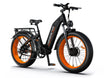
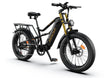
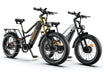
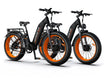
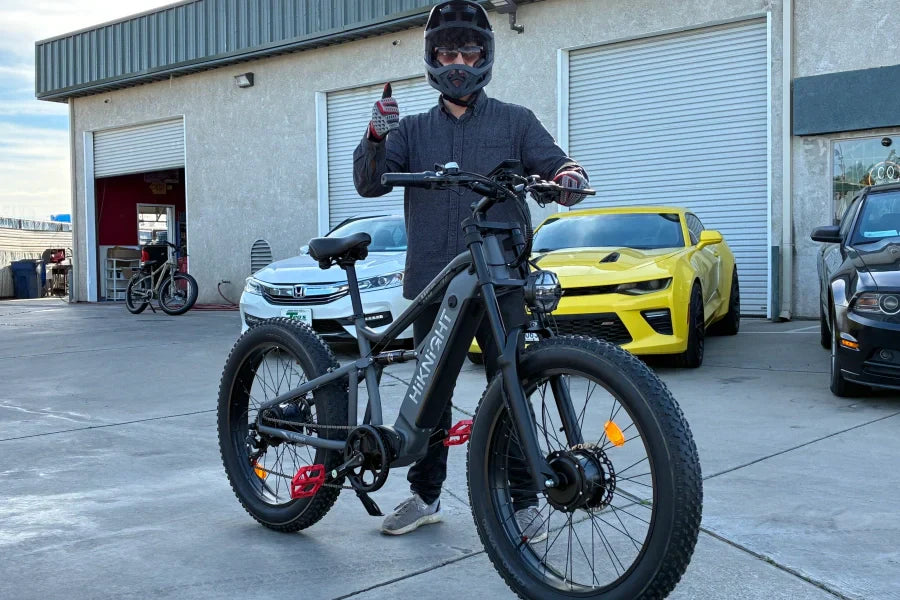
Outstanding models in this category are the H6 Pro Off-Road Ebike and H2 Pro Off-Road Ebike. Equipped with dual motors producing 3000W peak power and a substantial 52V 20Ah (1040Wh) battery system, they provide a manufacturers' rated range of 65 to 90 miles and a top speed of 38 MPH. They are built for riders seeking genuine all-terrain confidence and high-performance capability over longer trips.
Pros: Handles any terrain, stable ride, high range ceiling. Cons: Heavier, slightly less efficient on flat pavement vs. thin-tire commuters.
🚵 Long-Range Off-Road / Trail Ebikes
Best for: Mountain bikers and trail riders who want motor assist on technical terrain.
Key traits: Full suspension, mid-drive motor, 625–750Wh battery, aggressive geometry. Range is lower than commuter models due to terrain demands.
Pros: Best performance on technical trails. Cons: Expensive, overkill for road use, heavier.
📦 Long-Range Cargo Ebikes
Best for: Families, delivery riders, or anyone regularly hauling 50–400 lbs of cargo.
Key traits: Extended rear rack or longtail frame, high payload capacity, often dual-battery capable. Range drops significantly under heavy load.
Pros: Replaces a car for many errands. Cons: Large footprint, harder to store, expensive.
Side-by-Side Comparison: Long-Range Ebike Profiles
| Category | Real-World Range | Best Terrain | Typical Price | Weight | Ideal Rider |
|---|---|---|---|---|---|
| Commuter | 40–60 mi | Pavement | $1,500–$3,500 | 45–60 lbs | Daily commuters |
| Fat Tire (Off-Road) | 65–90 mi | All-terrain | $1,399–$1,799 | 70–85 lbs | Versatile adventurers |
| Off-Road / Trail | 30–50 mi | Trails, MTB | $3,000–$8,000+ | 50–65 lbs | Trail enthusiasts |
| Cargo | 30–55 mi | Urban, flat | $2,500–$6,000 | 70–100 lbs | Families, haulers |
Use Cases: Who Should Buy What
You commute 15–25 miles each way on paved roads
→ Long-range commuter ebike. Prioritize a 700Wh+ battery, integrated lights, and a comfortable upright geometry. You don't need fat tires — they'll slow you down on pavement.
You want one bike for everything — trails, gravel, beach, and city
→ Fat tire long-range ebike. The versatility trade-off (slightly less efficient on pavement) is worth it if you ride varied terrain. Look for a 1000Wh+ battery and dual-motor peak performance. The H6 Pro and H2 Pro models represent this category perfectly — they are engineered to tackle technical trails, deep sand, and snow without compromising the substantial battery capacity required for long journeys.
You ride technical mountain trails on weekends
→ Full-suspension trail ebike with mid-drive motor. Range will be lower due to terrain demands, but motor efficiency and suspension performance matter more here than raw battery size.
You haul kids, groceries, or gear regularly
→ Cargo ebike. Payload capacity and stability matter more than range here. Look for dual-battery options if you regularly carry heavy loads over long distances.
You're a casual weekend rider who wants to explore
→ Fat tire or hybrid long-range ebike. Comfort, stability, and enough range to explore without anxiety. A 60–80 mile range ceiling gives you freedom without over-spending on a performance-focused build.
Buying Guide: 7 Questions to Ask Before You Buy
1. What is your actual round-trip distance?
Calculate your longest realistic ride, add 20% buffer for hills and headwinds, then choose a bike whose real-world range (not claimed range) exceeds that number. A bike claiming 90 miles will realistically deliver 60–75 miles under typical riding conditions.
2. What terrain will you ride most?
Flat pavement → commuter. Mixed terrain → fat tire. Technical trails → full-suspension. Don't buy a trail bike for commuting or a commuter for trails.
3. Hub drive, dual-hub, or mid-drive?
Hub motors are simpler and require lower maintenance. Dual-hub motors offer incredible climbing power and traction across snow, mud, and sand. Mid-drive motors are highly efficient on technical steep climbs and offer a natural pedal feel but usually require more chain maintenance. For all-terrain adventure and high power, dual-hub systems are highly capable.
4. Can you charge at your destination?
If you can plug in at work or at a trailhead, you can effectively double your usable range. This changes the math significantly — a 40-mile real-world range bike becomes a 80-mile round-trip bike if you charge mid-day.
5. What is the warranty and after-sales support like?
Battery replacement is the biggest long-term cost of ebike ownership. A battery that costs $400–$800 to replace after 3–5 years is a real consideration. Look for brands that offer at least a 2-year battery warranty and have reliable support.
6. What is the bike's actual weight?
Long-range ebikes are heavier due to larger batteries and dual motors. If you need to carry the bike up stairs, load it into a vehicle, or store it in a small space, weight matters. Most long-range fat tire models run 70–85 lbs — manageable with a ramp or lift, but not something you'll want to carry up three flights of stairs daily.
7. Does the bike fit your body?
Frame size, standover height, handlebar reach, and saddle height all affect comfort on long rides. A bike with 80 miles of range is useless if you're in pain after 10 miles. Always check the manufacturer's size chart and, if possible, test ride before buying.
FAQ: Electric Bike Long Range
Q: What is considered a long-range electric bike?
A: Generally, any ebike capable of 50+ real-world miles per charge is considered long-range. Manufacturer claims of 60–90 miles typically translate to 40–70 miles under normal riding conditions (mixed terrain, average assist level, 180 lb rider).
Q: How far can an electric bike go on one charge?
A: It depends on battery size, motor efficiency, terrain, rider weight, and assist level. Entry-level ebikes average 20–35 miles. High-capacity models with 1,000Wh+ batteries, such as the 52V 20Ah setups, can exceed 65–90 miles in optimal pedal-assist conditions.
Q: Does riding faster reduce electric bike range?
A: Yes. Wind resistance increases exponentially with speed. Riding at 20 mph vs. 15 mph can reduce range by 20–30%. Throttle-only riding (no pedaling) also drains the battery significantly faster than pedal-assist mode.
Q: Are fat tire ebikes less efficient than regular ebikes?
A: On flat pavement, yes — fat tires create more rolling resistance and reduce range by roughly 10–15% compared to narrow tires at the same battery capacity. However, on gravel, sand, or uneven terrain, fat tires maintain traction and momentum better, reducing the motor's workload.
Q: How do I extend my electric bike's range?
A: The most effective strategies are: (1) use a lower assist level and pedal more actively, (2) maintain proper tire pressure, (3) avoid full-throttle riding, (4) keep the battery at 20–80% charge for daily use (preserves long-term capacity), (5) avoid riding in extreme cold, and (6) reduce cargo weight where possible.
Q: Is a 3000W peak motor less efficient than a 500W motor for long-range riding?
A: A more powerful motor draws more power at maximum output. However, on hilly or rough terrain, a larger motor does not need to work as hard to climb the same grade, which can prevent overheating and maintain efficiency. For flat, paved roads, a smaller motor is more efficient, whereas a 3000W peak system shines in tough, hilly, and off-road environments.
Q: What battery size do I need for 60 miles of real-world range?
A: As a general guideline, plan for approximately 12–15 Wh per mile under mixed conditions. For 60 dependable real-world miles, a high-capacity 52V 20Ah (1040Wh) battery provides the robust safety margin needed to reach your destination without range anxiety.
Q: Can I add a second battery to extend my ebike's range?
A: Some ebike models support dual-battery configurations, which can effectively double your range. Not all bikes support this — check the manufacturer's specifications before purchasing if extended range is a priority. Aftermarket dual-battery adapters exist but vary in quality and compatibility.






Leave a comment
All comments are moderated before being published.
This site is protected by hCaptcha and the hCaptcha Privacy Policy and Terms of Service apply.